Loading...
Searching...
No Matches
DotNetDupe::System::Random Class Reference
Represents a pseudo-random number generator, which is an algorithm that produces a sequence of numbers that meet certain statistical requirements for randomness. More...
#include <Random.h>
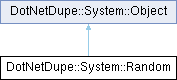
Inheritance diagram for DotNetDupe::System::Random:
Public Member Functions | |
| Random () | |
| Initializes a new instance of the Random class, using a time-dependent default seed value. | |
| Random (int seed) | |
| Initializes a new instance of the Random class, using the specified seed value. | |
| virtual int | Next () |
| Returns a non-negative random integer. | |
| virtual int | Next (int maxValue) |
| Returns a non-negative random integer that is less than the specified maximum. | |
| virtual int | Next (int minValue, int maxValue) |
| Returns a random integer that is within a specified range. | |
| virtual void | NextBytes (unsigned char *buffer, int bufferSize) |
| Fills the elements of a specified array of bytes with random numbers. | |
| virtual double | NextDouble () |
| Returns a random floating-point number that is greater than or equal to 0.0, and less than 1.0. | |
| Public Member Functions inherited from DotNetDupe::System::Object | |
| virtual | ~Object ()=default |
| Virtual destructor ensuring polymorphic cleanup. | |
| virtual bool | Equals (const Object &obj) const |
| Determines whether the specified Object is equal to the current Object. | |
| virtual int | GetHashCode () const |
| Serves as the default hash function. | |
| bool | operator== (const Object &obj) const |
| Determines reference equality between two objects. | |
| char * | ToStringA () const |
| Returns narrow-character string representation. | |
| wchar_t * | ToStringW () const |
| Returns wide-character string representation. | |
Additional Inherited Members | |
| Static Public Member Functions inherited from DotNetDupe::System::Object | |
| static bool | Equals (const Object &obj1, const Object &obj2) |
| Static helper determining whether two object instances are equal. | |
Detailed Description
Represents a pseudo-random number generator, which is an algorithm that produces a sequence of numbers that meet certain statistical requirements for randomness.
- Note
- Conforms to ECMA-335 Partition IV Section 5.19 (System.Random).
Constructor & Destructor Documentation
◆ Random() [1/2]
| DotNetDupe::System::Random::Random | ( | ) |
Initializes a new instance of the Random class, using a time-dependent default seed value.
Definition at line 7 of file Random.cpp.
◆ Random() [2/2]
| DotNetDupe::System::Random::Random | ( | int | seed | ) |
Initializes a new instance of the Random class, using the specified seed value.
- Parameters
-
seed A number used to calculate a starting value for the pseudo-random number sequence.
Definition at line 9 of file Random.cpp.
Member Function Documentation
◆ Next() [1/3]
|
virtual |
Returns a non-negative random integer.
- Returns
- A 32-bit signed integer that is greater than or equal to 0 and less than Int32.MaxValue.
Initialize Mersenne Twister engine with current seed and draw non-negative integer.
Definition at line 11 of file Random.cpp.
◆ Next() [2/3]
|
virtual |
Returns a non-negative random integer that is less than the specified maximum.
- Parameters
-
maxValue The exclusive upper bound of the random number to be generated.
- Returns
- A 32-bit signed integer that is greater than or equal to 0, and less than maxValue.
Sample uniform distribution across [0, maxValue].
Definition at line 18 of file Random.cpp.
◆ Next() [3/3]
|
virtual |
Returns a random integer that is within a specified range.
- Parameters
-
minValue The inclusive lower bound of the random number returned. maxValue The exclusive upper bound of the random number returned.
- Returns
- A 32-bit signed integer greater than or equal to minValue and less than maxValue.
Sample uniform distribution across [minValue, maxValue].
Definition at line 25 of file Random.cpp.
◆ NextBytes()
|
virtual |
Fills the elements of a specified array of bytes with random numbers.
- Parameters
-
buffer An array of bytes to contain random numbers. bufferSize The number of bytes to fill.
Generate random bytes across entire buffer span.
Definition at line 32 of file Random.cpp.
◆ NextDouble()
|
virtual |
Returns a random floating-point number that is greater than or equal to 0.0, and less than 1.0.
- Returns
- A double-precision floating point number that is greater than or equal to 0.0, and less than 1.0.
Sample uniform real distribution in interval [0.0, 1.0).
Definition at line 41 of file Random.cpp.
The documentation for this class was generated from the following files:
- Include/System/Random.h
- DotNetDupe/Random.cpp